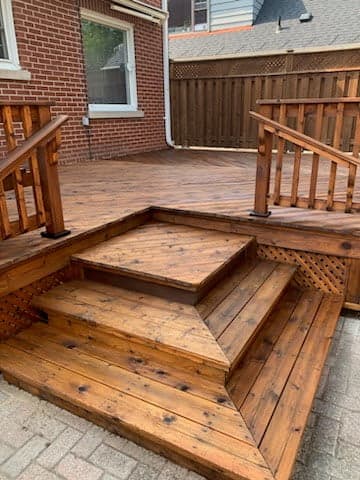
Walk into any home improvement store and you'll find dozens of deck stains on the shelf, split roughly into two categories: oil-based and water-based. The difference matters more than most homeowners realize — especially in Ontario's climate, where decks face harsh freeze-thaw cycles, high summer UV and significant moisture year-round.
At Restore My Deck, we've applied hundreds of stain jobs and almost exclusively use oil-based products. Here's why — and when water-based stains might be the better choice.
How Oil-Based Deck Stain Works
Oil-based stains use a penetrating carrier (linseed oil, modified oil or tung oil) to drive the pigment and protective compounds deep into the wood fibres rather than forming a film on top. This is the key advantage: when the stain is inside the wood, it can't peel.
The oils also condition the wood, keeping it flexible against the seasonal expansion and contraction that Ontario's temperature swings cause. This flexibility prevents cracking and checking — the small surface splits you see on neglected decks.
Our preferred products, Ready Seal and Penofin Verde, are both premium penetrating oil-based stains. They're VOC-compliant, eco-friendly and formulated specifically for exterior wood in North American climates.
How Water-Based Deck Stain Works
Water-based (latex) stains use water as the carrier and form a film on the wood surface as they dry. Modern water-based stains have improved significantly and some now offer decent penetration. Their advantages include:
- Faster drying time (2–4 hours vs. 24–48 hours for oil)
- Easier cleanup with soap and water
- Lower VOC content in older formulations (though this gap has narrowed as oil-based products have improved)
- Better performance on composite or modified wood decking
Key Differences at a Glance
| Feature | Oil-Based | Water-Based |
|---|---|---|
| Penetration | Deep (into wood fibres) | Surface to moderate |
| Peeling risk | Very low — fades gracefully | Higher if surface film breaks |
| Durability | 3–5 years (full restoration) | 2–4 years |
| Drying time | 24–48 hours | 2–6 hours |
| Wood conditioning | Excellent — prevents drying/cracking | Limited |
| Recoat prep | Light clean and sand | Full strip may be needed |
| Eco/VOC | Modern formulas now low-VOC | Generally low-VOC |
Why We Recommend Oil-Based for Ontario Decks
Ontario's climate is the decisive factor. Our freeze-thaw cycles (some areas see 40+ freeze-thaw cycles per year) are brutal on film-forming finishes. Water gets under the film, freezes, expands and lifts the coating. With a penetrating oil stain, there's no film to lift.
The other issue is the natural aging of oil-based stains: they fade evenly and gracefully. When it's time to recoat, you clean, lightly sand and apply a fresh coat — no stripping required. Water-based stains that have started to peel require stripping back to bare wood before recoating, which is significantly more labour-intensive (and expensive).
When to Consider Water-Based Stain
There are situations where water-based stains are the better choice:
- Composite decking — composite manufacturers typically recommend water-based products, as oils can leave residue that doesn't absorb
- Previously water-based stained decks — if the deck has been water-based stained and is in reasonable shape, switching to oil can cause adhesion issues without a full strip first
- IPE or dense tropical hardwoods — the tight grain doesn't absorb oils well; specific water-based hardwood finishes are formulated for these species
The Bottom Line
For standard pressure-treated, cedar or pine decking in Ontario — which covers the vast majority of residential decks — an oil-based penetrating stain applied by brush is the professional standard for a reason. It lasts longer, protects better and is easier to maintain over time.
Not sure which product or type is right for your deck? Contact us for a free quote and assessment — we inspect every deck before recommending a finish.